

With Meta CPMs climbing to $11.20 and LinkedIn lead costs reaching $150, the pressure to stop wasting marketing budget has reached a breaking point. You likely feel the daily anxiety of rising customer acquisition costs while managing a fragmented ecosystem of ten or more platforms. It's difficult to prove ROI to the board when your data is trapped in silos; this often leads to "zombie spend" that drains resources without driving results. We understand this sense of overwhelm and are here to replace it with the confidence of a streamlined, high-level perspective.
By following this strategy, you will learn how to identify hidden waste and reclaim your ROI through actionable marketing intelligence. We will show you how to achieve a 20% or greater increase in budget efficiency by transforming chaotic inputs into a clear customer journey map. This guide previews the shift from manual, tedious reporting to automated predictive modeling that secures your competitive edge for 2026. It's time to turn your passive data into an active participant in your business growth.
Key Takeaways
- Identify "zombie spend" by uncovering non-incremental touchpoints that inflate reports without driving actual revenue growth.
- Deploy AI-driven multi-touch attribution to finally stop wasting marketing budget on the invisible gaps within fragmented customer journeys.
- Audit your technology stack to eliminate data redundancy and establish a unified governance framework for total strategic clarity.
- Shift from reactive reporting to predictive modeling to accurately forecast the commercial impact of every dollar spent across your entire ecosystem.
- Upgrade your organizational intelligence by transforming fragmented data into active participants that guide your strategic growth recommendations.
The Invisible Leak: Why Marketing Budget Waste is Rising in 2026
Marketing budget waste is no longer a simple accounting error; it's a strategic failure that threatens the stability of your entire growth engine. In 2026, we define waste as capital allocated to non-incremental or misattributed touchpoints. This isn't just about ads that don't convert. It's about paying for conversions that would have happened anyway or losing sight of the channels that actually move the needle. Global marketing waste has ballooned into a $140 billion problem because many organizations still rely on "gut-feeling" decisions rather than integrated, automated intelligence.
The reality of the modern customer journey is one of extreme fragmentation. Your typical buyer now interacts with your brand across 15 or more devices and platforms before making a purchase. This complexity creates a massive "Attribution Gap." Revenue is generated, but the credit is lost in the digital noise. If you want to stop wasting marketing budget, you must first acknowledge that your current visibility is likely compromised by these hidden leaks.
The Cost of Fragmented Data
When your data lives in separate silos like Meta, Google, and your CRM, it creates a "hall of mirrors" effect. Each platform claims credit for the same sale, leading to inflated reports and misguided confidence. This fragmentation doesn't just cost money; it drains your team's most valuable asset: time. Marketing teams now spend an average of 20 hours every week on manual reporting and data stitching. This is a productivity tax that prevents your best minds from focusing on high-level strategy. You can bridge these gaps and unify your data into a single source of truth using the Nodal Platform, which transforms chaotic inputs into profitable decisions.
The "Zombie Spend" Phenomenon
"Zombie spend" refers to campaigns that appear profitable on a dashboard but provide zero incremental lift to your bottom line. This often happens when brands over-invest in branded search terms or aggressive retargeting. If a customer was already committed to a purchase, paying for that final click is redundant. Traditional marketing attribution models, specifically last-click models, are the primary drivers of this waste. They reward the final touchpoint while ignoring the complex middle-of-the-funnel interactions that actually built the intent. To stop wasting marketing budget, you must move beyond these surface-level metrics and implement a system that measures true incrementality. Only then can you stop feeding the "zombies" and start scaling the channels that deliver genuine growth.
Beyond Last-Click: How Multi-Touch Attribution Exposes Waste
Single-touch attribution is a relic of a simpler digital age. If your goal is to stop wasting marketing budget, you must look beyond the final click. Relying on last-click data is like giving the person who scored the goal 100% of the credit while ignoring the players who made the pass and the defensive plays that kept the game alive. AI-driven Multi-Touch Attribution (MTA) provides the necessary visibility to value every player on your team. It replaces the anxiety of guesswork with the calm efficiency of data-backed decisions.
MTA assigns scientific weight to the "invisible" middle of the funnel. It identifies your "Hero" channels. These are the touchpoints that initiate the customer journey or rekindle interest during long sales cycles. Without these initiators, your final conversions would never happen. Shifting your perspective through sophisticated marketing attribution allows you to reallocate funds from low-performing final touchpoints to the high-impact drivers that actually build your pipeline. This is the cognitive upgrade your marketing department needs to thrive in 2026.
Deconstructing the Multi-Channel Journey
Mapping the path from first discovery to final conversion requires more than just tracking clicks. You must measure "Time-to-Value" metrics to understand how quickly a channel moves a prospect through the funnel. UK enterprises are increasingly leading the shift toward first-party data attribution to maintain accuracy in a post-cookie environment. This move ensures that your data remains compliant with local regulations while providing a clear, unfiltered view of the customer journey. By owning your data, you eliminate the noise and gain a competitive edge in budget planning. Understanding these patterns allows you to transform passive tracking into active growth.
Incremental Lift: The Truth About ROI
To truly stop wasting marketing budget, you must master the concept of incrementality. Ask yourself a difficult question: would this sale have happened without the ad? AI tools now allow you to run "what-if" scenarios on potential budget cuts to see the actual impact on revenue. This helps you identify spend that is merely subsidizing sales you would have secured anyway. A robust growth framework relies on this level of competitive analysis to ensure every pound spent is additive. This approach eliminates the "Walled Garden" bias found in platform-specific reporting. Instead of believing Meta or Google's internal metrics, you get a neutral, high-level perspective on actual performance. If you are ready to see the truth behind your numbers, consider how multi-touch attribution can transform your ROI overnight.
Strategy vs. Guesswork: Building a Growth Framework
Stop reacting to historical data and start dictating your future growth. Traditional reporting tells you what happened last month, but it offers no protection against the market shifts of tomorrow. To stop wasting marketing budget, you must transition from a defensive posture to a proactive strategy. This means shifting the core question of your board meetings from "What did we get for our spend?" to "What will happen if we increase our investment by 20%?" This forward-looking approach turns your marketing department from a cost center into a predictable revenue engine.
Achieving this requires a delicate balance between short-term ROAS and long-term brand equity. While immediate returns keep the lights on, over-optimising for the bottom of the funnel eventually starves your brand of new prospects. Integrating predictive modelling into your quarterly planning allows you to see the ripple effects of every decision. It provides the clarity needed to invest in brand-building activities that secure your market position for years to come. You are no longer guessing; you are engineering growth with precision.
Predictive Modelling as a Budget Safeguard
AI-driven simulations act as a digital twin for your marketing ecosystem. Instead of committing millions to an unproven channel, you can simulate market changes and competitor moves before a single penny leaves your account. AI identifies diminishing returns in real-time, alerting you the moment a campaign starts to lose its edge. This marks the end of the traditional "test and learn" era. We are entering the age of "simulate and scale," where risk is mitigated by intelligence rather than luck. This transition replaces the anxiety of uncertainty with the confidence of verified data.
The Role of Customer Journey Mapping
Strategic clarity comes from understanding the nuances of the customer journey. By mapping every interaction, you can identify the specific friction points that cause budget leakage and lead to churn. Are your ads promising something your landing page doesn't deliver? Is there a gap between discovery and conversion? Aligning your creative production with high-converting touchpoints ensures that your message resonates at the exact moment of intent. This level of precision is the only way to ensure your budget is an investment, not an expense. To stop wasting marketing budget, you must treat every touchpoint as a deliberate step toward a commercial outcome.
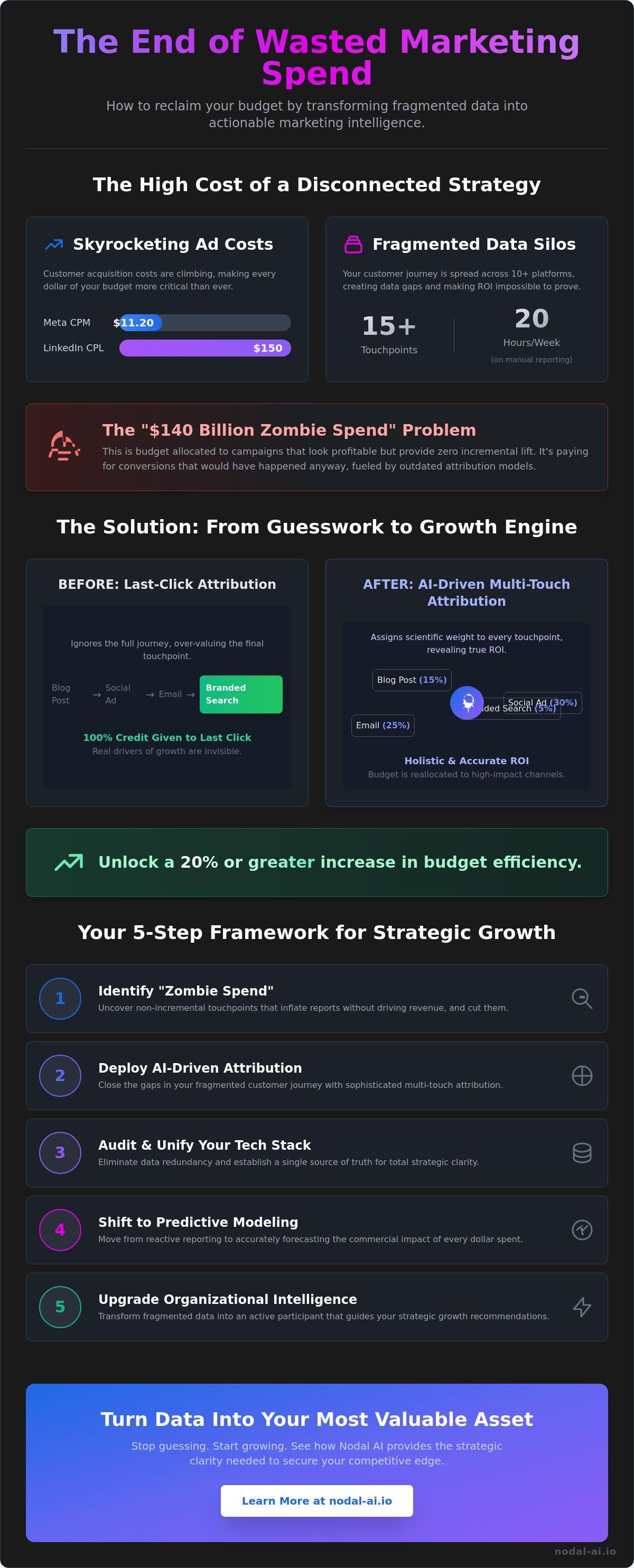
5 Steps to Reclaim Your Budget and Scale ROI
Reclaiming your financial resources isn't just about cutting costs; it's about re-engineering your entire marketing operation for maximum impact. To stop wasting marketing budget, you must follow a structured roadmap that replaces fragmented guesswork with integrated intelligence. This journey takes you from the anxiety of data siloes to the confidence of predictive scaling. It's a five-step process designed to turn your marketing department into a high-performance revenue engine.
Step 1 & 2: Consolidation and Governance
Start by auditing your tech stack to identify "ghost" platforms. These are redundant applications that charge you for data storage and processing without delivering unique incremental value. Many businesses pay for multiple tools that essentially perform the same function, creating unnecessary overhead. Once you've trimmed the redundancy, you must implement a data governance framework to ensure compliance and clarity across all touchpoints. This framework acts as a bridge between your disparate data sources, creating a single version of the truth that your entire organization can trust. Data unification is the indispensable foundation upon which every profitable marketing decision is built.
Step 3-5: Automation and Predictive Growth
With a clean data foundation, you can finally move beyond the limitations of last-click reporting. Implementing a multi-touch attribution model allows you to see the true value of every interaction in the customer journey, exposing the waste hidden in misattributed channels. You should then transition from manual spreadsheets to real-time, automated dashboards. This shift alone can save your team 20 or more hours of manual labor per week, effectively handing back a full day of strategic thinking to your most valuable talent. To stop wasting marketing budget in real-time, set automatic alerts that notify you the moment a campaign's efficiency drops below your target threshold.
Finally, stop looking in the rearview mirror for answers. Use AI-driven growth recommendations to scale your winning campaigns with predictive confidence scores. These scores quantify the likelihood of success if you increase spend, allowing you to invest your capital with surgical precision. If you're ready to stop the leaks and start scaling, it's time to explore how the Nodal Platform unifies your marketing data for total strategic clarity.
Nodal AI: Turning Fragmented Data into Strategic Clarity
You've identified the invisible leaks and deconstructed the multi-channel journey. Now, you need the engine to drive this transformation. Nodal AI acts as a cognitive upgrade for your marketing department, moving you past basic analytics into the realm of high-value outputs. The Nodal Platform doesn't just show you numbers; it provides the strategic clarity required to stop wasting marketing budget across every channel. By turning your passive data into an active participant in your business process, we help you transition from the anxiety of manual reporting to the confidence of automated growth.
Our solution is designed for the modern professional who is tired of the "hall of mirrors" effect created by siloed platforms. We replace complexity with calm efficiency. When you integrate Nodal, you aren't just buying software; you're gaining a problem-solver persona that understands the nuances of your financial performance. This is where chaotic inputs finally become profitable decisions.
Why Nodal Leads the UK Market
Our London-based team understands that UK enterprises face unique challenges, particularly regarding data privacy and complex, multi-touch journeys. We don't offer a one-size-fits-all tool. Instead, we provide custom onboarding that specifically maps your unique customer journey, ensuring no touchpoint is left behind. Our tiered SaaS models are built to scale with your data volume, providing enterprise-ready power that remains approachable for growth-stage companies. We focus heavily on Growth Recommendations that actually impact your bottom line. We prioritize commercial value over academic jargon, making our insights immediately actionable for your board meetings.
Your Journey to Total Clarity Starts Here
Experience the immediate relief of seeing every single touchpoint in a single, unified view. This transparency removes the ambiguity that leads to "zombie spend" and over-investment in redundant channels. On average, Nodal clients identify and reclaim 15% of their wasted spend within the first 90 days of implementation. This rapid return on investment is possible because we eliminate the guesswork that plagues traditional marketing. You'll no longer wonder which half of your budget is being wasted. Instead, you'll have the predictive confidence to scale your winners and cut the laggards in real-time. It's time to stop wasting marketing budget and start engineering your growth with surgical precision. Book a demo of the Nodal Platform today and see how we transform your fragmented data into a competitive advantage.
Take Command of Your Marketing ROI
The era of marketing by "gut feeling" has officially reached its end. By embracing multi-touch attribution and predictive modelling, you've learned how to transform fragmented data into a clear, strategic roadmap for the future. This transition from reactive reporting to proactive growth recommendations is the only way to effectively stop wasting marketing budget in an increasingly complex digital landscape. You now possess the framework to audit your tech stack and implement unified governance that ensures every pound spent is an investment in genuine incrementality.
The Nodal Platform provides the cognitive upgrade your organisation needs to thrive. With our London-based expert support and enterprise-grade data governance, you can replace the exhaustion of siloed tracking with the clarity of a unified vision. It's time to turn your passive assets into active participants in your commercial success. Stop the leak and reclaim your ROI with the Nodal Platform. You're ready to lead with precision, secure measurable returns, and dominate your market in 2026 and beyond.
Frequently Asked Questions
What is the most common cause of marketing budget waste?
Misattribution is the primary driver of wasted capital in modern marketing. When multiple platforms like Meta and Google claim credit for the same conversion, you end up paying for the same customer twice. This "zombie spend" drains your resources into touchpoints that provide zero incremental lift to your bottom line.
How can AI help me stop wasting my marketing budget?
AI identifies the specific patterns that lead to profitable outcomes by processing millions of data points in real-time. It reveals which ads are actually driving new revenue and which are simply claiming credit for existing demand. This level of intelligence allows you to stop wasting marketing budget by reallocating funds to high-performing "Hero" channels before the waste accumulates.
What is the difference between last-click and multi-touch attribution?
Last-click attribution awards all credit to the final touchpoint before a sale, while multi-touch attribution (MTA) distributes value across the entire customer journey. MTA exposes the hidden "middle of the funnel" interactions that last-click models ignore. This provides a much more accurate view of how different channels work together to drive a conversion.
Is multi-touch attribution software UK compliant with GDPR?
Yes, reputable multi-touch attribution software in the UK is fully GDPR compliant when it prioritizes first-party data strategies. By moving toward server-side tracking and away from third-party cookies, these platforms protect consumer privacy while maintaining data accuracy. This ensures your growth remains compliant with the latest 2026 regulatory standards.
How long does it take to see results from a marketing analytics platform?
Most organisations see measurable improvements within the first 90 days of implementation. At Nodal, our clients typically identify a 15% reduction in wasted spend during this initial period. The immediate visibility into the customer journey allows for rapid budget shifts that impact your ROI almost instantly.
Can predictive modelling work for small-to-medium marketing budgets?
Predictive modelling is highly effective for any budget size because it focuses on efficiency rather than volume. Even with a smaller spend, AI can simulate market changes and identify diminishing returns. This prevents you from over-investing in expensive channels that don't scale, ensuring every pound is spent with precision.
How much time does automated reporting actually save?
Automated reporting saves the average marketing team over 20 hours of manual labor every week. Instead of stitching together spreadsheets from ten different platforms, your team receives a unified, real-time dashboard. This hands back a full day of productivity, allowing your talent to focus on high-level strategy instead of tedious data entry.
Why should I use Nodal AI over standard platform reporting like Google Analytics?
Nodal AI offers a neutral, cross-platform perspective that standard tools cannot provide. While platform-specific reporting often carries a "walled garden" bias, the Nodal Platform unifies data from all sources into a single version of the truth. We provide proactive growth recommendations rather than just historical data, acting as a cognitive upgrade to stop wasting marketing budget and scale with confidence.


