

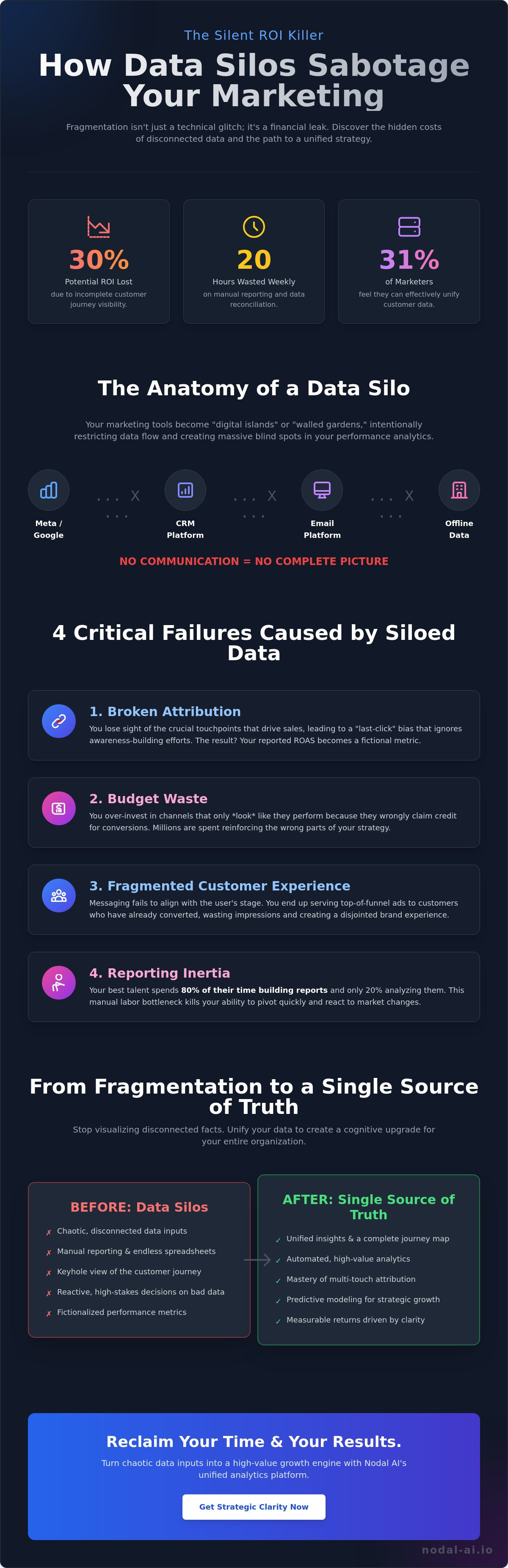
Your marketing technology environment likely spans 20 separate platforms, yet only 31% of marketers feel they can actually unify their customer data. This fragmentation isn't just a technical glitch; it's a financial leak. Industry leaders estimate that you could be losing up to 30% of your potential ROI because the core problems with siloed marketing data make it impossible to see a complete customer journey. When Meta, Google, and your CRM offer three different versions of the truth, you aren't just wasting 20 hours a week on manual reporting. You're making high-stakes budget decisions based on fictionalized performance metrics that don't reflect reality.
You deserve the clarity that comes from a single source of truth. We understand the pressure of managing inaccurate ROAS calculations while navigating the complex new 2026 privacy requirements in states like Indiana and Oregon. This article reveals how to turn chaotic data inputs into high-value growth engines. Discover the strategic framework to unify your insights, master multi-touch attribution, and finally implement automated reporting that actually works for your organization. We will explore the five critical ways fragmentation sabotages your performance and provide the roadmap to reclaim your time and your results.
Key Takeaways
- Understand how isolated information pockets act as invisible barriers to growth and why identifying the core problems with siloed marketing data is the first step toward reclaiming your ROI.
- Identify why your current attribution is broken and how "walled gardens" lead to expensive budget waste by masking the true customer journey.
- Learn how to audit your "digital islands" and transition from fragmented reporting to a unified Single Source of Truth (SSOT).
- Master the strategic framework required to automate your reporting and replace manual labor with high-level performance marketing analytics.
- Discover how to leverage predictive modelling to turn chaotic data inputs into a cognitive upgrade for your entire marketing organization.
What are Marketing Data Silos and Why Do They Stunt Growth?
Marketing data silos are isolated pockets of information where critical customer insights live in total seclusion. Think of your Meta Ads manager, your email marketing platform, and your CRM as three different libraries that speak three different languages. They don't share books, and they certainly don't share intelligence. This fragmentation creates invisible barriers that prevent you from seeing the high-level perspective required for scalable growth. Instead of a clear map, you're left with a jigsaw puzzle where half the pieces are missing.
In 2026, these barriers have become even more restrictive. New state privacy laws in Indiana, Kentucky, and Rhode Island, along with updated CCPA rules, have tightened how data moves between systems. When your data is trapped, you can't comply efficiently or optimize effectively. One of the primary problems with siloed marketing data is that it forces you to make million-dollar decisions based on a keyhole view of the customer journey. You're reacting to chaotic inputs rather than commanding actionable intelligence.
The Anatomy of a Silo: Where Your Data Gets Trapped
Data fragmentation starts when your tools stop talking to each other. Ad platforms like Google and LinkedIn act as digital islands, intentionally restricting how much information they export to keep you within their walled gardens. Your CRM might track a final sale, but it rarely communicates with the top-of-funnel activity that sparked the initial interest. Offline conversions and third-party data sources often remain entirely disconnected, leaving a massive blind spot in your performance marketing analytics. Without a bridge between these islands, your understanding of the customer is purely speculative.
The Difference Between a Dashboard and a Unified Platform
Many teams believe they've solved their data issues by plugging various sources into a visualization tool. This is a mistake. Simply "visualizing" siloed data in a dashboard doesn't fix the underlying fragmentation; it just gives you a prettier view of the same disconnected facts. You don't need another chart. You need a robust data governance framework to ensure the integrity of every byte entering your system.
True unification goes beyond surface-level reporting. It creates a cognitive upgrade for your organization, allowing ai marketing analytics to function with precision. While only 31% of marketers report being fully satisfied with their ability to unify data sources, those who bridge the gap replace manual labor with automated, high-value outputs. Stop looking at snapshots and start building a single, fluid source of truth that drives measurable returns.
4 Critical Problems Caused by Siloed Marketing Data
Fragmentation isn't just a technical inconvenience. It is an active drain on your growth. When information stays trapped within separate platforms, the resulting friction creates systemic failures across your entire funnel. These problems with siloed marketing data manifest as expensive errors that most teams don't even realize they're making until the quarterly review reveals a massive disconnect between reported wins and actual bank balances.
Address these four critical failures before they compromise your 2026 targets:
- Broken Attribution: You lose sight of the touchpoints that actually drive the sale, leaving you blind to the true customer journey.
- Budget Waste: You over-invest in channels that only "look" like they perform because they claim credit for conversions they didn't actually initiate.
- Fragmented Customer Experience: Your messaging fails to align with the user's stage, serving "top-of-funnel" ads to customers who have already converted.
- Reporting Inertia: Your best talent spends 80% of their time building reports and only 20% analyzing them, killing your ability to pivot quickly.
The Attribution Crisis: Why Your ROAS is a Lie
Silos create a "last-click" bias that habitually over-values brand search while ignoring the awareness-building work of social or content. This skew makes your reported ROAS a fictional metric. Achieving true marketing attribution accuracy requires a unified view that accounts for every touchpoint, from the first impression to the final click. The Revenue Leak is the delta between your platform-reported ROI and the actual capital hitting your organization's bottom line.
Operational Friction: The Cost of Manual Data Stitching
Manual data stitching is a significant emotional drain on marketing teams. "Excel gymnastics" shouldn't be a core competency for your top strategists. This tedious process leads to burnout and human error, turning what should be a data-driven culture into one of manual labor. Transition from this chaotic state to a posture of calm efficiency by letting technology handle the heavy lifting.
For London-based marketing teams, automating these streams saves upwards of 20 hours per week. That is half a work week reclaimed for high-level strategy and creative optimization. If you're ready to stop the manual grind, exploring a unified performance marketing platform can provide the cognitive upgrade your organization needs to scale. Replace the anxiety of conflicting spreadsheets with the confidence of a single, automated source of truth.
Root Causes: Why Marketing Data Becomes Siloed in 2026
Silos are rarely a deliberate choice. They are usually the unintended consequence of rapid growth and a lack of centralized data governance. As you scale, you add specialized tools to solve specific problems. By 2026, the average marketing technology environment spans 17 to 20 separate platforms. While each tool serves a purpose, they often lack native integration, creating a digital environment where information is archived rather than activated. This tech sprawl is a primary driver for the problems with siloed marketing data that sabotage your strategic clarity.
Departmental friction complicates the issue. Sales teams live in the CRM, marketing teams reside in ad managers, and finance teams focus on the ledger. When these departments operate with different "sources of truth," the organization loses its ability to pivot. In fact, 51% of sales leaders report that tech silos are actively delaying or limiting their AI initiatives. You aren't just managing a business; you're reconciling three conflicting versions of reality every Monday morning.
The Walled Garden Trap
Platforms like Google, Meta, and Amazon benefit from keeping your data siloed. By restricting data export and making cross-platform comparison difficult, they protect their own attribution models. They want you to see their channel as the primary driver of every sale. This calculated restriction prevents you from identifying where your budget is actually working and where it's simply overlapping.
To break free, you need a system that bridges these gardens without violating the strict 2026 privacy regulations in states like Indiana or Oregon. AI-powered insights now allow you to transform fragmented data into a unified perspective. By using a platform that centralizes these inputs, you move from being a passive observer of platform reports to an active commander of your own intelligence.
Legacy Mindsets vs. Future-Facing Analytics
The most persistent barrier to total clarity is often the "way we've always done it." Relying on manual exports and reactive reporting is a legacy mindset that cannot survive in a high-velocity market. The shift from manual labor to proactive growth recommendations is not just a technical upgrade; it's a cognitive one for your entire team.
Stop settling for fragmented snapshots that force you to guess your next move. The Nodal Platform represents the future of this transition. It replaces the anxiety of disconnected spreadsheets with a visionary framework that turns chaotic inputs into profitable decisions. Move beyond the status quo and embrace an analytics infrastructure designed for the complexities of 2026.
The Strategic Framework: How to Break Down Marketing Silos
Breaking down silos requires more than just connecting tools; it requires a structural shift in how you process intelligence. The inherent problems with siloed marketing data persist only as long as you allow fragmented tools to dictate your strategy. To reclaim your ROI, you must move from a posture of reactive reporting to one of proactive command. This five-step framework turns chaotic inputs into high-value growth engines.
- Step 1: Conduct a Data Audit. Identify your digital islands. Catalog every platform, from Meta Ads to your internal CRM, to see exactly where information is being archived rather than activated.
- Step 2: Establish a Single Source of Truth (SSOT). Centralize your data into a unified engine. This isn't just a dashboard; it's a cognitive upgrade that ensures every department works from the same set of facts.
- Step 3: Implement Multi-Touch Attribution. Connect the dots across the entire journey. Stop guessing which channels deserve credit and start seeing the actual path to purchase.
- Step 4: Automate the Flow. Integrity requires speed. Remove manual intervention to eliminate human error and reclaim the 20+ hours your team spends on "Excel gymnastics" every week.
- Step 5: Move to Predictive Insights. Use your unified data to forecast future growth. Transition from looking at what happened to predicting what will happen next.
Centralization vs. Integration: Choosing the Right Engine
Simple API connections are just pipes; they don't solve the underlying logic gaps in your reporting. Integration without a processing engine leads to the same data fragmentation in a different location. You need a centralized architecture where the customer journey serves as the spine of your intelligence. This approach ensures enterprise-ready security and high-level protection of your data assets while providing the transparency needed for 2026 compliance.
The Role of AI in Unifying Fragmented Data
AI identifies patterns across disparate sources that human analysts simply miss. It transforms chaotic inputs into high-value outputs automatically, bridging the gap between walled gardens and your internal ledger. By personifying your passive data assets, AI turns them into active participants in your business process. In 2026, AI is the only way to scale journey mapping effectively across 20+ platforms. It replaces the anxiety of complexity with the confidence of streamlined, high-level perspectives.
Ready to turn your fragmented data into a scalable growth engine? Discover how our unified performance marketing platform can unify your insights today.
From Fragmented Data to Predictive Growth: The Nodal AI Advantage
Fragmentation is a choice you no longer have to make. Nodal AI specifically targets the systemic problems with siloed marketing data by replacing disconnected tools with a unified intelligence layer. We turn your chaotic inputs into a streamlined engine for growth, ensuring that your data assets become active participants in your commercial success. Transition from the anxiety of conflicting reports to the confidence of a single, verified truth.
For global enterprise teams and London-based marketing leaders, we provide more than just software. We offer a strategic partnership that understands the nuances of the 2026 regulatory environment and the necessity of measurable returns. Our approach replaces manual, tedious tasks with high-level perspectives, allowing you to stop managing spreadsheets and start leading your market. Empower your team with the tools they need to move beyond survival and into scalable expansion.
Nodal Platform: Your Single Source of Truth
The Nodal Platform acts as a cognitive upgrade for your entire marketing organization. By centralizing disparate streams into a unified engine, we deliver automated reporting that saves your team upwards of 20 hours every week. This isn't just about efficiency; it's about clarity. Faster decisions require a streamlined, high-level perspective that only a true Single Source of Truth can provide. Replace the noise of 20+ non-integrated tools with a professional, enterprise-ready platform that prioritizes your ROI over platform-specific vanity metrics.
Take Control of Your Marketing Intelligence
Mastering future-facing analytics is the ultimate competitive advantage in a fragmented landscape. While your competitors struggle with "Excel gymnastics" and broken attribution, you can leverage the power of predictive modelling to identify future trends before they manifest. This shift from reactive reporting to proactive growth recommendations ensures that every pound spent is an investment in a documented outcome.
Stop letting silos leak your revenue and compromise your strategic vision. Reclaim your time, unify your insights, and lead your organization toward a future of total clarity. The journey from chaotic data to profitable growth starts with a single decision to integrate. Book a demo of the Nodal Platform today and see how we transform your marketing intelligence into your most valuable asset.
Command Your Growth with Unified Intelligence
The transition from fragmented snapshots to predictive clarity is the most significant cognitive upgrade your organization can undertake in 2026. You've identified how isolated pockets of information act as invisible barriers to your ROI. Now, you have the framework to bridge those gaps and turn chaotic inputs into high-value outputs. By establishing a single source of truth, you replace the anxiety of conflicting reports with the confidence of a streamlined, high-level perspective.
Solving the core problems with siloed marketing data requires more than just better tools; it requires a visionary partner. With our London-based expert support and AI-powered multi-touch attribution, you can finally visualize the full customer journey while saving 20+ hours every week on manual reporting. This is your roadmap to scalable growth and long-term stability. Your data shouldn't be a passive asset; it should be an active participant in your commercial success.
Transform your fragmented data into growth with Nodal AI
Your organization is ready for total transparency. Take the first step toward reclaiming your time and your results today.
Frequently Asked Questions
What is the most common cause of marketing data silos?
The primary cause of fragmentation is rapid MarTech sprawl. Marketing teams frequently adopt specialized tools to solve immediate hurdles without a centralized integration strategy. By 2026, the average organization manages 17 to 20 separate platforms. This fragmented approach turns your technology into a collection of digital islands rather than a cohesive growth engine, archiving information instead of activating it.
How much revenue do businesses lose due to siloed data?
Industry research indicates that businesses lose between 20% and 30% of their potential marketing ROI because of fragmentation. These problems with siloed marketing data stem from misallocated budgets and inaccurate ROAS calculations. When you can't see which touchpoints actually drive sales, you over-invest in channels that only appear to perform while starving your most effective growth drivers of capital.
Can I fix data silos without replacing my entire MarTech stack?
You don't need to rip and replace your existing tools to achieve total clarity. The solution is implementing a unified data layer that acts as a cognitive upgrade for your current stack. This framework centralizes your disparate sources into a single source of truth. You keep the tools your team loves while gaining the high-level perspective required for scalable growth and streamlined performance.
What is the difference between a data silo and a data lake?
A data silo is an isolated pocket of information that is inaccessible to other systems or departments. A data lake is a centralized repository designed to store vast amounts of raw data in its native format. While a data lake solves the storage issue, it still requires a processing engine to turn that raw input into the actionable intelligence your marketing team needs to drive results.
How does siloed data affect marketing attribution?
Siloed data forces a "last-click" bias that habitually over-values brand search and bottom-funnel activity. It prevents you from connecting the dots across the full customer journey. Without a unified view, your attribution is essentially a guess. You lose the ability to see how awareness-building channels contribute to final conversions, leading to expensive strategic errors and a fictionalized version of performance.
Is AI necessary to break down marketing data silos?
AI is essential for organizations managing 20 or more platforms in 2026. Manual analysis can't keep pace with the volume and velocity of modern marketing inputs. AI identifies patterns across disparate sources that human analysts miss. It transforms chaotic data into growth recommendations, allowing your team to focus on high-level strategy rather than the anxiety of manual labor.
How long does it typically take to unify siloed marketing data?
You can see immediate improvements in operational efficiency within the first week of implementing a unified framework. Automating your reporting streams typically reclaims 20 hours of manual work per week right away. Achieving a full, predictive single source of truth generally takes a few weeks, depending on the complexity of your digital islands and your existing data governance standards.
What are the security risks of having siloed marketing data?
Having problems with siloed marketing data creates significant compliance risks under the 2026 privacy laws in states like Indiana, Kentucky, and Oregon. Fragmented systems make it nearly impossible to honor universal opt-out signals or manage sensitive data across all platforms. Unification replaces these security blind spots with a transparent, enterprise-ready protection layer that keeps your data assets secure and compliant.


