

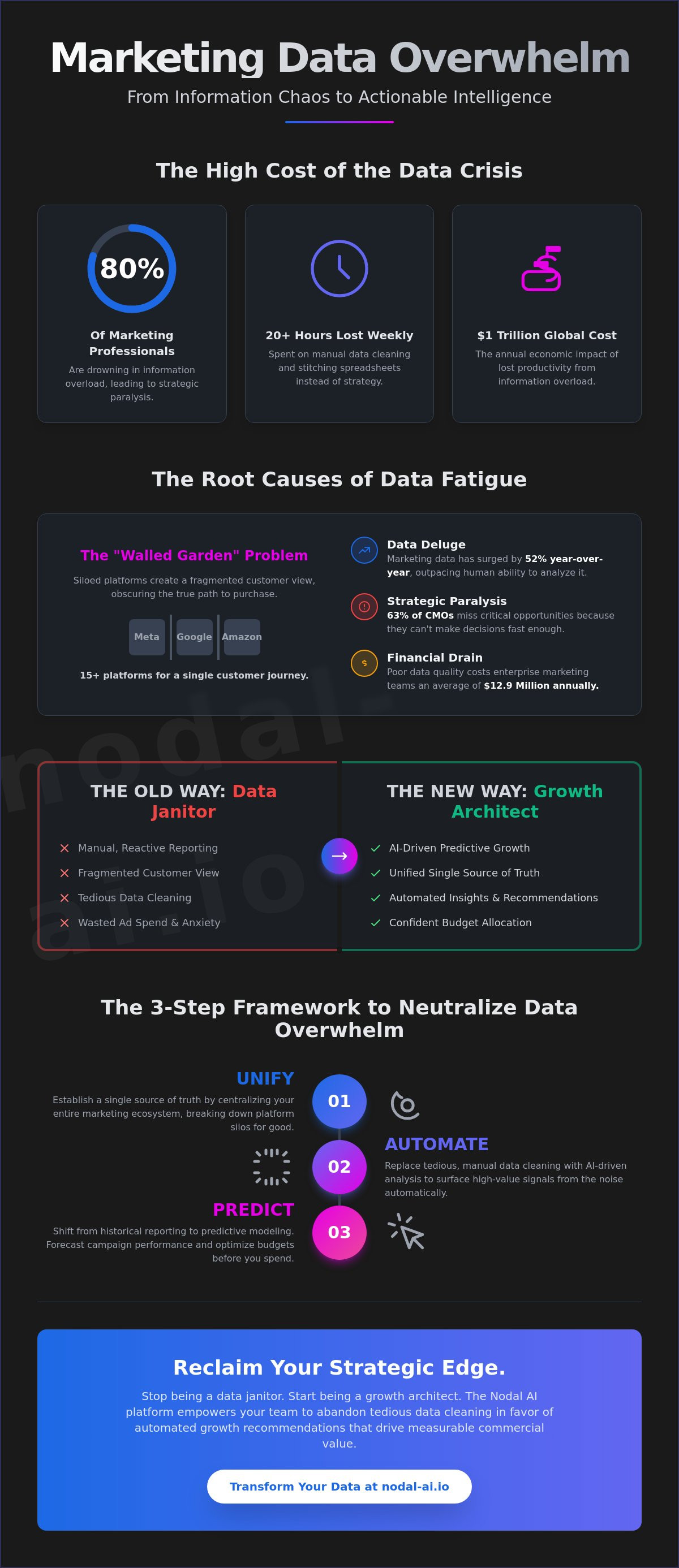
80% of marketing professionals are currently drowning in information overload, a cognitive tax that costs the global economy $1 trillion annually in lost productivity. You likely spend 20 or more hours every week manually stitching spreadsheets together, only to end up with a fragmented view of the customer journey and persistent anxiety over wasted ad spend. It's a frustrating cycle that stalls decision making and obscures your true ROI.
It's time to stop acting as a data janitor and start acting as a growth architect. By implementing the right marketing data overwhelm solutions, you can transform chaotic inputs into a streamlined engine for expansion. This article provides a strategic framework for 2026 to help you move beyond manual reporting into the realm of AI-driven intelligence. You'll learn how to establish a single source of truth, automate complex insights without a data science degree, and gain the clarity needed for bold budget reallocation. Prepare to replace the stress of ambiguity with the confidence of total performance transparency.
Key Takeaways
- Shift from simple data visibility to true data intelligence to bridge the gap between collection and actionable growth.
- Implement a strategic 3-step framework for marketing data overwhelm solutions that filters high-value signals from fragmented platform noise.
- Replace manual, reactive reporting with predictive modelling to forecast campaign performance and optimize budgets before they are spent.
- Centralize your marketing ecosystem through the Nodal Platform to achieve a single source of truth for multi-touch attribution and customer journey mapping.
- Empower your team to abandon tedious data cleaning in favor of automated growth recommendations that drive measurable commercial value.
The Marketing Data Crisis: Why CMOs are Drowning in 2026
In 2026, the volume of marketing data has surged by 52% year-over-year. Yet, 63% of CMOs report they are missing critical business opportunities because they cannot make decisions fast enough. This is the core of the marketing data crisis. We define marketing data overwhelm as the widening chasm between the massive volume of data we collect and our actual ability to extract actionable intelligence from it. We aren't just drowning in data; we are starving for clarity. The sheer scale of information has outpaced human cognition, turning a potential asset into a heavy organizational burden.
The traditional belief held that more data points would lead to a sharper picture of the customer. The reality is the opposite. Every new channel adds a layer of noise that obscures the signal. Without effective marketing data overwhelm solutions, your data remains a liability. It sits in silos, creating a fragmented view of the customer journey that leads to strategic paralysis and wasted ad spend. This isn't just a technical glitch. It is a systemic risk that threatens your competitive edge and long-term stability.
The Deluge of Fragmented Touchpoints
The explosion of digital channels has created billions of disconnected touchpoints. A single customer might interact with your brand across fifteen different platforms before making a purchase. Traditional dashboards fail because they focus on platform-specific metrics that don't talk to each other. They provide visibility without intelligence. Human teams cannot manually digest this scale of marketing inputs. When you rely on manual processes, you lose the ability to see the cohesive journey, leaving you with a collection of "walled garden" snapshots that fail to reflect the actual customer experience.
The Hidden Cost of 'Analysis Paralysis'
Analysis paralysis is a financial leak that drains your resources every day. Marketing teams currently lose an average of 20 hours a week to manual data cleaning and cross-referencing. When insights arrive days or weeks late, your budget decisions are already obsolete. The average annual cost of poor data quality for an enterprise marketing organization has reached $12.9 million. This financial impact is paired with a heavy emotional toll. Your best strategic minds are stuck in the "data pits," performing repetitive tasks that kill creative productivity. This leads to systemic Data Fatigue. In this state, your team becomes reactive rather than proactive, eventually causing a total breakdown in strategic momentum and growth.
Beyond Dashboards: Identifying the Root Causes of Data Fatigue
A dashboard is a window, but it isn't a map. Most marketing teams confuse data visibility with data intelligence. Visibility is the act of seeing your metrics in a colorful chart; intelligence is the clarity of knowing exactly which lever to pull next. When you lack marketing data overwhelm solutions, you're merely observing the chaos rather than controlling it. This distinction is vital because having more charts often leads to less action. True intelligence requires a cognitive layer that interprets the "why" behind the "what."
The primary driver of this exhaustion is the "Walled Garden" problem. Platforms like Meta, Google, and Amazon are designed to keep you within their ecosystems. They provide platform-specific data that rarely aligns with other systems, creating a fragmented reality. This fragmentation is one of the leading causes of information overload, as marketers are forced to act as human bridges between incompatible datasets. For high-growth enterprises, manual reporting isn't just a nuisance; it is the silent growth killer that prevents agile scaling.
The Myth of the Single Source of Truth
Your CRM and your ad platforms often tell conflicting stories. One claims a lead came from a search ad, while the other insists it was an organic social touchpoint. This "fog of war" happens because your data lacks a unified foundation. Relying on siloed metrics for global marketing strategies is a recipe for wasted spend. To resolve this, you must implement a robust data governance framework. Without this structure, your "single source of truth" is nothing more than a collection of expensive contradictions.
The Attribution Gap in 2026
Modern buyer behavior is non-linear and complex. Fragmented data breaks your ability to track a cohesive customer journey, making it impossible to see the true path to conversion. Rule-based models, such as "last-click," have become expensive hallucinations. They ignore the ten touchpoints that preceded the final click, leading to poor budget allocation and missed opportunities. By the time you realize a campaign isn't working, you've already lost the window for optimization. Moving toward performance marketing analytics allows you to bridge this gap, replacing guesswork with mathematical certainty.
Instead of chasing fragments, you must demand a unified perspective. The goal is to move from reactive reporting to a state of calm efficiency where every data point serves a commercial purpose. When your systems talk to each other, the fatigue disappears, replaced by the confidence of streamlined, high-level perspectives.
The 3-Step Strategy to Neutralise Data Overwhelm
Stop reacting to the noise. Commanding your data requires a structural shift in how you process information. While some suggest "taking a deep breath" or manual organization, we advocate for a cognitive upgrade. High-growth organizations don't just manage data; they weaponize it. By adopting specific marketing data overwhelm solutions, you replace manual labor with automated precision. This framework moves you from a state of constant catching up to a position of proactive control.
This strategy follows a logical, multi-step journey toward total clarity. It starts with a ruthless audit, moves into the removal of manual friction, and concludes with the implementation of advanced attribution. Each step is designed to strip away the complexity that currently stalls your progress. Follow these three phases to turn your data from a burden into a competitive engine.
- Step 1: Audit and Consolidate. Identify high-value signals vs. distracting noise.
- Step 2: Automate the Mundane. Eliminate the 20+ hours of manual reporting that drains your team's energy.
- Step 3: Implement Multi-Touch Attribution. Gain a unified, automated view of the entire customer journey.
Auditing Your Marketing Intelligence Stack
Audit your stack with ruthless pragmatism. Identify which data sources actually drive decision-making. Redundant dashboards create a "hall of mirrors" effect where metrics are reflected across multiple platforms with slight, confusing variations. Use a "Kill Your Darlings" approach. If a dashboard doesn't directly lead to a budget reallocation or a strategy shift, delete it. Focus on setting clear KPIs that align with revenue growth rather than vanity metrics that only provide a false sense of activity. A lean stack is a fast stack.
Automating the Reporting Lifecycle
Static PDFs are where data goes to die. Moving toward automated reporting acts as a cognitive force multiplier for your entire organization. It ensures that insights are delivered through dynamic, real-time intelligence feeds rather than weekly snapshots. This shift is transformative. It frees your best strategic minds from the "data pits," allowing them to focus on creative execution and high-level strategy. Automation doesn't just save time; it removes the ambiguity that leads to expensive hesitation. When your reporting is automated, your path to growth becomes inevitable. This is how you reclaim your strategic edge and move beyond the limits of marketing data overwhelm solutions that rely on human labor.
From Reactive Reporting to Predictive Growth
In 2026, 63% of CMOs report missing critical business opportunities because they can't make decisions fast enough. This speed gap exists because most teams are trapped in reactive reporting, looking at last month's performance to make tomorrow's decisions. Effective marketing data overwhelm solutions break this cycle by shifting the focus from historical analysis to future strategy. You need to know what to do next, not just what failed yesterday. For London enterprises operating in hyper-competitive markets, this transition is the difference between leading the market and merely following it.
AI-driven insights now identify trends before they manifest in standard spreadsheets. This allows you to set strategy before budgets are committed. By leveraging predictive modelling, you can run complex "What-If" scenarios to simulate the impact of market shifts. You can forecast the likely return on a 15% spend increase in a specific channel before you ever sign off on the budget. This turns your data into a proactive growth engine rather than a passive record of past spend.
Turning Insights into Actionable Recommendations
A statistic is just a number; a growth recommendation is a directive. Most platforms bury you in stats, but true intelligence provides a path forward. AI analyzes your omnichannel touchpoints to identify underperforming channels in real-time. It doesn't just show you that your customer acquisition cost is rising; it tells you why and suggests where to reallocate that budget for a higher return. This level of clarity allows you to justify every pound of marketing spend to the board with total confidence. You aren't just presenting data. You're presenting a validated plan for revenue generation.
Mastering Multi-Touch Attribution (MTA)
If you're still relying on single-touch models, you're making decisions based on a fiction. Modern marketing attribution is the definitive cure for data overwhelm. It assigns precise value to every touchpoint in the buyer's journey, from the first discovery on social media to the final conversion through email. MTA provides the transparency needed to scale profitable channels aggressively while cutting the waste that hidden "shadow" channels often create. When you understand the true weight of every interaction, you can optimize your entire ecosystem for maximum efficiency.
Ready to see the future of your performance? Explore how our predictive modelling tools can transform your strategy today.
Reclaiming Your Strategic Edge with Nodal AI
The journey from fragmentation to growth requires more than just a change in mindset. It requires a foundational shift in your technology stack. The Nodal Platform serves as the definitive answer to the chaos of modern analytics. While other tools act as passive repositories, Nodal transforms your data into an active participant in your business process. We provide the marketing data overwhelm solutions that allow you to stop managing spreadsheets and start managing outcomes. By centralizing your intelligence layer, you replace the anxiety of manual reporting with the confidence of high-level perspectives.
Our platform is engineered for the complexities of 2026. It integrates Customer Journey Mapping, Multi-Touch Attribution, and Predictive Modelling into a single, intuitive interface. This isn't just a technical upgrade; it's a cognitive upgrade for your entire marketing organization. We empower you to see the invisible connections between touchpoints, allowing you to scale what works and discard what doesn't with mathematical precision. Based in London, we combine global-scale technology with local expertise and enterprise-ready security to protect your most valuable assets.
The Nodal Advantage: Clarity as a Service
Complexity shouldn't be a barrier to entry. Nodal simplifies the onboarding process, even for the most fragmented data environments. We turn chaotic inputs into actionable growth intelligence almost immediately. Marketing teams using our platform report saving over 20 hours a week on manual data tasks. That is half a work week reclaimed for every team member. Instead of cleaning data, your experts can now focus on high-value creative strategy and market expansion. We provide the clarity you need to move from "what happened" to "what will happen" with total transparency.
Take the Next Step Toward Data Mastery
Imagine a future where you never have to guess your ROI. Picture a boardroom meeting where every budget recommendation is backed by predictive certainty. This is the reality for organizations that have moved beyond the limits of traditional reporting. You've seen the framework and understood the crisis. Now, it's time to act. Don't let another week of lost productivity and wasted ad spend stall your growth. Reclaim your strategic edge and transform your data into your greatest competitive advantage.
Ready to see your data through a new lens? Book a strategic consultation with our experts today and discover how Nodal can streamline your path to profitable growth.
Secure Your Strategic Advantage in the Age of Intelligence
The era of manual data stitching is over. By adopting a framework that prioritizes automated reporting and multi-touch attribution, you move from the anxiety of ambiguity to the confidence of total performance transparency. You've seen how the shift from reactive reporting to predictive growth can reclaim your team's strategic edge. Implementing robust marketing data overwhelm solutions is no longer a luxury; it's the baseline for survival in a 2026 landscape defined by fragmented touchpoints and rapid market shifts.
Nodal AI provides the cognitive upgrade your organization needs to thrive. With our London-based AI expertise, we help you deploy multi-touch attribution built specifically for the complexities of 2026. Our automated reporting doesn't just provide clarity; it saves your team 20+ hours weekly, turning passive data into active commercial value.
Ready to turn your fragmented data into actionable growth? Explore the Nodal Platform today.
Your path to data mastery is clear. Step into a future where every decision is backed by mathematical certainty and every campaign is optimized for maximum impact. The complexity of the modern market is your opportunity to lead.
Frequently Asked Questions
How do I know if my marketing team is truly overwhelmed by data?
Your team is overwhelmed if they spend more time cleaning data than acting on it. Look for clear warning signs like 20 or more hours lost every week to manual reporting or a persistent inability to see a cohesive customer journey. These symptoms indicate a processing gap that requires specific marketing data overwhelm solutions to bridge effectively.
Can AI really solve the problem of fragmented data from different platforms?
AI unifies fragmented data by acting as a cognitive bridge between disconnected "walled garden" platforms like Meta and Google. It identifies the underlying patterns that human teams often miss, transforming separate datasets into a single, cohesive customer journey. This moves your organization beyond platform-specific snapshots toward a unified strategic perspective.
What is the difference between a standard dashboard and an AI insights platform?
A standard dashboard provides visibility, while an AI insights platform delivers intelligence. Dashboards simply display what has already happened through static charts. In contrast, an AI platform interprets that data to provide growth recommendations, essentially telling you which levers to pull next for maximum commercial impact.
How much time can automated reporting realistically save a marketing team?
Marketing teams using the Nodal Platform report saving over 20 hours per week on manual data tasks. By removing the need for manual cross-referencing and spreadsheet updates, your best strategic minds are freed from the "data pits." This reclaimed time is better spent on high-level strategy and creative execution that drives revenue.
Is multi-touch attribution necessary for small to mid-sized marketing budgets?
Multi-touch attribution is essential for any budget size because it exposes the "shadow channels" where spend is often wasted. Even with smaller budgets, understanding the true weight of every interaction prevents expensive hallucinations caused by last-click models. It ensures every pound is allocated to the touchpoints that actually drive conversions.
How does Nodal AI ensure data governance and GDPR compliance for UK businesses?
Nodal AI leverages London-based expertise to maintain enterprise-ready security and strict GDPR compliance for UK businesses. We treat data governance as a foundational pillar rather than an afterthought. Our platform ensures that your high-value assets are protected while remaining accessible for streamlined, high-level analytics and marketing data overwhelm solutions.
What are the first steps to transitioning from manual to automated marketing analytics?
The transition begins with a ruthless audit of your current intelligence stack to identify redundant dashboards. Once you've isolated high-value signals, the next step is to centralize these inputs through the Nodal Platform. This shift replaces manual friction with automated reporting, creating an immediate path toward data mastery and strategic clarity.
How does predictive modelling help in reducing wasted ad spend?
Predictive modelling reduces wasted spend by allowing you to forecast campaign outcomes before you commit your budget. By running "What-If" scenarios, you can simulate the impact of budget reallocations across different channels. This transforms your strategy from reactive guesswork into a proactive, validated plan for growth.


