

What if your customer journey map didn't just show you where your users have been, but told you exactly where they're going next? In an environment where 92% of executives are scaling their AI investments, relying on static visualizations is no longer just inefficient; it's a commercial liability. You've likely felt the frustration of disconnected data silos and the pressure of trying to justify marketing spend with inaccurate attribution. It's exhausting to build journey maps that become obsolete within weeks while your customer acquisition costs continue to rise without a clear explanation.
You deserve a clear roadmap for your marketing spend and a unified view of the entire customer lifecycle. This guide will show you how to move from manual, tedious tracking to AI-driven foresight with the right predictive customer journey mapping tool. We'll compare the leading platforms for 2026, evaluating how they navigate new data privacy laws in states like Indiana and Kentucky while delivering automated growth recommendations. We're here to help you find the cognitive upgrade your organization needs to turn chaotic data into high-value returns.
Key Takeaways
- Replace obsolete, static diagrams with live prescriptive intelligence to anticipate customer needs and behaviors in real-time.
- Identify a high-performance predictive customer journey mapping tool by its capacity to integrate first-party data with advanced modelling engines.
- Distinguish between basic visual design tools and enterprise-grade analytics platforms that support sophisticated multi-touch attribution standards.
- Justify every dollar of marketing spend by shifting from backward-looking reports to automated growth recommendations that drive measurable returns.
- Learn how the Nodal Platform acts as a cognitive upgrade, transforming fragmented data into a unified engine for profitable growth.
Beyond Visualization: Why Static Customer Journey Mapping is Obsolete in 2026
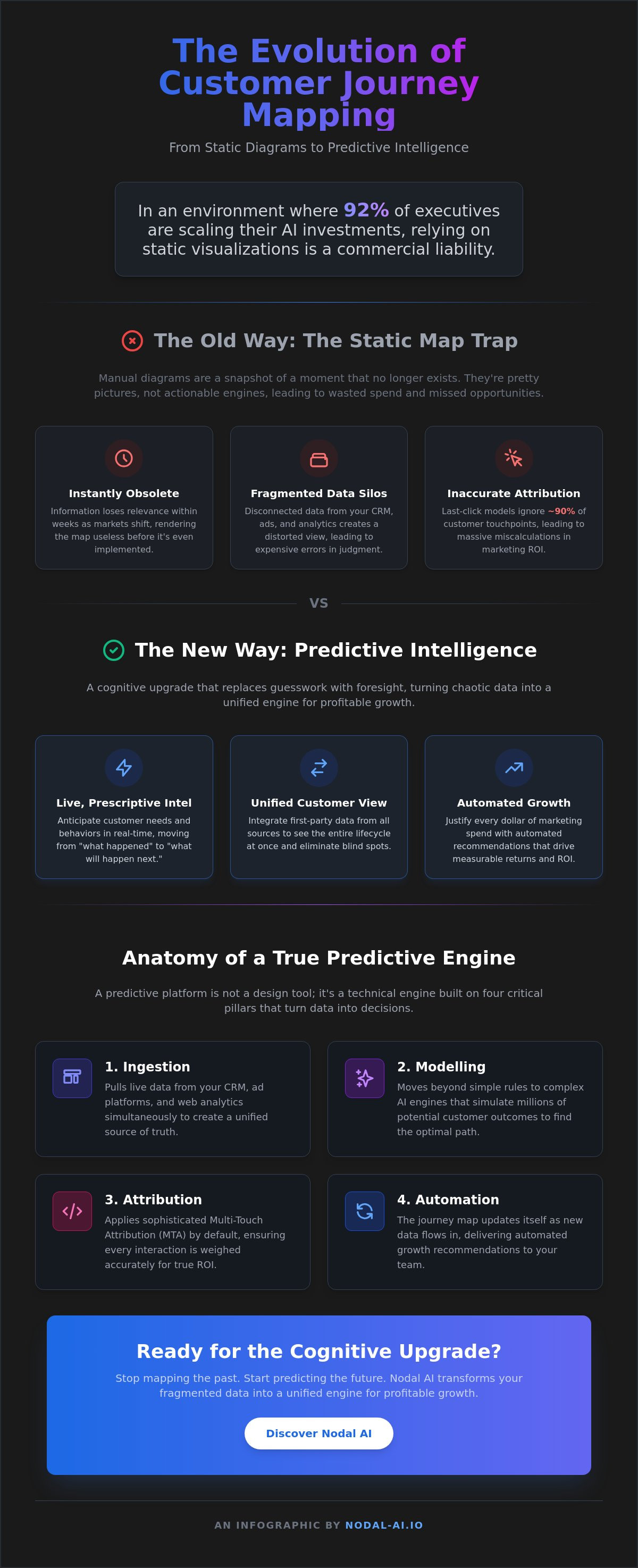
Manual diagrams are a snapshot of a moment that no longer exists. They're pretty pictures, not actionable engines. In the 2026 digital environment, your customers don't walk a straight line. They jump across devices, social platforms, and offline touchpoints with lightning speed. Relying on static customer journey mapping results in a design exercise rather than a commercial strategy. These diagrams fail to capture the fluid reality of modern behavior. This leaves teams with a map that's obsolete before the ink is dry. Stop treating your maps as art projects and start treating them as live data assets.
The shift from descriptive analytics to prescriptive intelligence is the defining move of this year. Descriptive analytics tell you that a customer churned yesterday. Prescriptive intelligence tells you they're likely to churn tomorrow and identifies the exact offer needed to retain them. A modern predictive customer journey mapping tool shifts your focus from the rearview mirror to the windshield. It transforms the customer journey from a passive document into an active participant in your business growth. If your map doesn't update as the data flows, it's a liability.
- The Static Map Trap: Manual diagrams can't account for the 20+ touchpoints typical of a 2026 B2B or high-value B2C path.
- Data Decay: Information in a static map loses its relevance within weeks as market conditions and consumer sentiments shift.
- Siloed Vision: Fragmented data across your tech stack creates a distorted view of reality, leading to expensive errors in judgment.
The Cost of Reactive Marketing
Relying on last-click attribution is a dangerous gamble. This outdated approach ignores roughly 90% of the actual customer touchpoints, crediting the final click while ignoring the weeks of influence that built that intent. In the UK, where digital complexity has reached a fever pitch, this leads to massive miscalculations in marketing ROI. You end up over-investing in bottom-of-funnel tactics while your brand awareness starves. The productivity loss is equally staggering. Teams spend hours manually stitching together reports that an automated system could generate in seconds. Reactive marketing is a drain on resources; proactive intelligence is a multiplier for them.
From Fragmented Data to Strategic Clarity
Fragmented data silos are the primary barrier to growth. When your CRM doesn't talk to your ad platforms, you're flying blind. You need a unified source of truth to achieve total clarity. This is where the Nodal Platform provides a cognitive upgrade for your marketing team. It replaces manual labor with automated precision, allowing you to see the entire lifecycle at once. Predictive mapping is the intersection of multi-touch attribution and artificial intelligence. It turns chaotic inputs into high-value outputs, giving you the confidence to scale your spend without the guesswork.
The Anatomy of a True Predictive Customer Journey Mapping Tool
A true predictive customer journey mapping tool isn't a canvas for drawing; it's a technical engine for deciding. While basic visualization tools allow you to sketch what you think is happening, a predictive engine uses your actual data to tell you what's inevitable. It replaces guesswork with a structured flow of information that connects every touchpoint into a cohesive narrative. To move beyond the limits of manual diagrams, you must prioritize a platform built on four specific pillars: ingestion, modelling, attribution, and automation.
- Ingestion: The tool must pull from your CRM, ad platforms, and web analytics simultaneously to create a unified view.
- Modelling: It moves from simple "if-this-then-that" rules to complex predictive modelling engines that simulate millions of potential customer outcomes.
- Attribution: Multi-touch attribution (MTA) should be the default, not an add-on, to ensure every interaction is weighed accurately.
- Automation: The map should update itself as new data enters the system, transforming a static asset into a live growth engine.
By focusing on these pillars, you turn chaotic inputs into high-value outputs. You stop being a passive observer of the customer journey and start being its architect. If you're ready to see how these elements combine into a single interface, explore the Nodal Platform to gain total clarity over your marketing performance.
Core Technical Requirements for 2026
Seamless data flow requires an API-first architecture. This ensures your tool isn't an island but a connected hub that breathes with your tech stack. AI excels here by identifying hidden patterns in user behavior that even the most seasoned human analyst would miss. Because we're operating in 2026, GDPR-compliant data governance is a baseline requirement. Your tool must protect your assets while it optimizes them, ensuring transparency is baked into the code. This level of security replaces the anxiety of manual compliance with the confidence of automated protection.
Predictive vs. Descriptive: Knowing the Difference
Descriptive analytics is a post-mortem; it tells you who left your funnel yesterday. Predictive intelligence is a forecast; it tells you who will leave tomorrow. This distinction is where the "Next Best Action" capability comes alive. Instead of wondering why a lead went cold, the system suggests the exact content or offer needed to keep them engaged. Machine learning plays a vital role here by calculating Customer Lifetime Value (CLV) in real-time. This helps you prioritize high-value paths over low-return noise, ensuring your marketing spend is always directed toward the most profitable outcomes.
Comparison Framework: Visualization Tools vs. Predictive Analytics Platforms
Choosing the right technology depends entirely on your objective. Are you trying to draw a map, or are you trying to drive a result? In 2026, the market is strictly divided into three categories based on implementation time, data depth, and actionability. Understanding where your current stack sits is the first step toward replacing chaos with clarity. While visual tools have their place in the initial discovery phase, they cannot function as a predictive customer journey mapping tool because they lack a live data pulse.
- Category 1: Visual Design Tools (Miro, Lucidchart). These are best for brainstorming and internal alignment. They provide a blank canvas for sketching ideas, but they're static and disconnected from your actual performance data.
- Category 2: CX/UX Mapping Platforms (UXPressia, Smaply). These tools focus on empathy and design thinking. They're excellent for visualizing personas, yet they often struggle to predict future churn or conversion events.
- Category 3: Predictive Performance Platforms (Nodal AI, 6sense). These are built for ROI and growth. They ingest live data to identify high-performing paths and provide automated recommendations for your next move.
The difference lies in the engine. A visual tool is like a paper map; it's helpful until you hit a detour. A predictive platform is like a GPS; it recalculates in real-time as your customers move. If your goal is to justify marketing spend to the board, you need a system that treats the customer journey as a live growth asset. It's about moving from a descriptive state to a prescriptive one where the path to revenue is always visible.
When to Choose Design-Led Mapping
Design-led tools are perfect for the early stages of product discovery. They help teams align on the theoretical path a customer might take. Use these when you need to get stakeholders in a room to agree on a vision or a basic user flow. Just remember that these maps are manual. They require a rigorous data governance framework to ensure the information remains even remotely accurate. Without a live connection to your CRM, these diagrams quickly become expensive wall art that fails to reflect actual multi-device behavior.
The Power of Intelligence-Led Mapping
Intelligence-led mapping is the standard for performance marketing teams who are tired of "reporting hell." Manual reporting often consumes 20 hours a week, leaving no time for actual strategy. A true predictive customer journey mapping tool automates this labor. It provides a unified view of the customer lifecycle while baking growth recommendations directly into the interface. This shift replaces the anxiety of manual data entry with the confidence of automated, high-level perspectives. You stop looking for problems and start executing solutions.
Selection Criteria: Evaluating Predictive Accuracy and Integration Depth
Selecting a predictive customer journey mapping tool requires a shift in perspective. You aren't just buying software; you're investing in a decision-making partner. The market is full of platforms that promise "AI," but few deliver the integration depth required for true accuracy. You need a system that breathes with your CRM, ad platforms, and web analytics. If the data connectivity is fragmented, the resulting map is a fiction. Prioritize tools that support multi-touch attribution software UK standards. This ensures every pound of spend is accounted for across the entire customer lifecycle.
Don't settle for tools that require a PhD to operate. A marketing manager should be able to extract value without calling a data scientist for every report. Look for platforms that offer growth recommendations rather than just more charts. Actionability is the only metric that matters. If your current system leaves you with more questions than answers, it's time for a change. Ready to transform your data into a strategic growth asset? See the Nodal Platform in action.
Data connectivity is the foundation of any reliable model. Your tool must ingest data from your CRM, ad platforms, and web analytics seamlessly. Without this unified view, you're looking at a fractured reality. A true predictive engine bridges these gaps, turning siloed information into a coherent story of user intent. The most advanced tools in 2026 don't just provide data; they provide direction. This is the difference between descriptive reporting and prescriptive intelligence.
Testing for Predictive Reliability
Verify accuracy by backtesting models against your historical data. If the tool can't predict what already happened, it won't predict what's coming. Incrementality is the gold standard of modern attribution. It measures the true value of a touchpoint by asking what would have happened without it. In 2026, real-time processing is non-negotiable. Stale data leads to stale decisions. You need a system that reacts as fast as your customers do. This level of responsiveness replaces the anxiety of guesswork with the confidence of data-backed precision.
Total Cost of Ownership (TCO)
Look beyond the monthly SaaS fee. Consider the total cost of implementation and onboarding. Many enterprise tools hide these behind complex contracts. More importantly, calculate the "Cost of Inaction." Every day you spend with inefficient ad spend is revenue lost to your competitors. Evaluate the time saved through automated reporting and data cleaning. Reclaiming 20 hours a week for your team is a significant commercial win. High-value outputs require streamlined inputs, and your tool should handle the heavy lifting automatically.
Nodal AI: The Cognitive Upgrade for Predictive Journey Orchestration
Nodal AI isn't just another software vendor; it's a strategic growth partner. While other platforms offer passive repositories for your maps, the Nodal Platform transforms fragmented marketing data into profitable decisions. It acts as the cognitive upgrade your organization needs to navigate the complexities of 2026. By combining multi-touch attribution with advanced predictive modelling in a single interface, we eliminate the blind spots that plague traditional marketing stacks. This integration ensures that your predictive customer journey mapping tool is always fed with accurate, weighted data that reflects reality.
London marketing teams are already seeing the impact of this transition. By replacing manual data stitching with automated reporting, these organizations are reclaiming over 20 hours every single week. This isn't just about saving time; it's about reallocating your most valuable human assets toward high-level strategy and creative execution. As the preferred ai marketing analytics partner for UK enterprises, Nodal provides the transparency and measurable returns that the modern board demands. We turn chaotic inputs into high-value outputs with calm efficiency.
From Data Chaos to Growth Recommendations
The Nodal dashboard is engineered for faster decisions rather than just better maps. We understand the "Action Gap" that stalls most marketing departments. You build a map, but the next move remains unclear. Our Growth Recommendations feature solves this by analyzing live data to suggest the exact paths that will reduce your acquisition costs. Because we offer London-based support and implementation teams, our UK clients benefit from a partner that understands their specific market nuances. We replace the anxiety of manual labor with the confidence of streamlined, high-level perspectives.
Ready to Solve the Attribution Puzzle?
Stop guessing where your next customer is coming from. Nodal acts as the bridge between your raw data and your high-level commercial strategy. We invite you to move from intuition-based marketing to a state of data-driven certainty. It's time to treat your customer journey as a live, predictive engine that drives consistent growth. You don't need more charts; you need more clarity. This is the future of journey orchestration, delivered with the precision your business deserves.
Book a Nodal Platform demo to see predictive mapping in action and discover how a true predictive customer journey mapping tool can redefine your performance marketing results for 2026.
Mastering the Future of Journey Orchestration
Static diagrams are a liability in a multi-device world. You've seen how descriptive data only looks backward, leaving your strategy exposed to shifting market conditions. True competitive advantage in 2026 requires a shift from manual visualization to live, prescriptive intelligence. By integrating first-party data with advanced modelling, you turn passive assets into active growth drivers. Selecting the right predictive customer journey mapping tool is the first step toward reclaiming your team's time and justifying every pound of marketing spend.
Nodal AI provides the cognitive upgrade your organization needs. With our London-based expert support and AI-driven multi-touch attribution, you can replace the anxiety of fragmented data with the confidence of automated growth recommendations. We're here to help you move from chaotic inputs to high-value returns with streamlined efficiency. It's time to stop guessing and start growing.
Transform your fragmented data into growth recommendations, Explore the Nodal Platform. Your path to total clarity and measurable ROI starts here.
Frequently Asked Questions
What is a predictive customer journey mapping tool?
A predictive customer journey mapping tool is an AI-driven engine that uses historical and real-time data to forecast future customer behavior. It moves beyond simple diagrams to identify high-probability paths to conversion or churn before they happen. This technology allows you to anticipate needs rather than just reacting to past actions.
How does predictive mapping differ from traditional journey mapping?
Traditional mapping is descriptive; it looks backward to summarize what already occurred. Predictive mapping is prescriptive; it looks forward to show what will happen next. It replaces manual, static guesswork with automated intelligence that updates as your data flows, turning a passive asset into a live growth engine.
Can these tools integrate with my existing CRM and ad platforms?
Yes, enterprise-grade platforms use API-first architectures to ingest data from CRMs like HubSpot and major ad platforms simultaneously. This creates a unified source of truth across your entire tech stack. Seamless integration ensures that your predictive customer journey mapping tool has the comprehensive data needed for accurate forecasting.
Is multi-touch attribution (MTA) included in predictive mapping tools?
True predictive platforms include multi-touch attribution by default to weigh every interaction across the lifecycle accurately. This ensures the model understands which specific touchpoints drive actual incrementality. Without MTA, a predictive tool cannot properly value the early-stage influences that lead to a final conversion.
How long does it take to implement a predictive mapping platform?
Implementation typically takes a few weeks to fully connect your data sources and train the initial models. This process involves linking APIs, cleaning historical data, and configuring the dashboard for your specific commercial goals. Once the initial ingestion is complete, the system begins providing automated insights almost immediately.
Do I need a data science team to use predictive mapping software?
No, modern platforms are designed for marketing managers to operate without deep technical specialization. The complex predictive modelling happens in the background, while the user interface provides clear growth recommendations and automated reporting. You get the power of advanced data science without the need for a dedicated internal team.
How accurate are the growth recommendations provided by AI?
Accuracy is verified by backtesting the models against your historical data to ensure they can predict known outcomes. Because these systems identify non-linear patterns that humans often miss, they provide a higher level of certainty for marketing spend. High-quality tools constantly refine their logic as more data enters the system.
What is the ROI of using a predictive customer journey tool?
The ROI manifests as reduced customer acquisition costs and a massive gain in team productivity. By identifying high-value paths and automating 20+ hours of manual reporting each week, you reclaim resources for strategic execution. A predictive customer journey mapping tool replaces inefficient spend with data-backed certainty, driving measurable financial returns.


