

A data-driven marketing culture is not a human training problem; it is a technical infrastructure problem solved by AI-driven clarity. Many leaders struggle with building a data-driven marketing culture because they are fighting fragmented data across multiple platforms and wasted ad spend. It is exhausting when your team relies on intuition because your current systems are too complex to navigate. You need a way to turn chaotic inputs into high-value outputs without the manual grind.
In 2026, success requires navigating new privacy hurdles like Indiana’s ICDPA and Oregon’s updated consumer laws. This guide shows you how to transform fragmented datasets into a high-performance culture that prioritizes AI-driven insights over guesswork. You will learn to leverage multi-touch attribution and predictive modelling to gain total clarity on marketing performance. We provide a strategic roadmap to automate your reporting and accelerate decision-making cycles, ensuring every dollar spent is backed by proven ROI.
Key Takeaways
- Transition from the "Intuition Era" to the "Intelligence Era" by grounding every marketing decision in predictive modelling and AI-validated insights.
- Establish the four pillars of building a data-driven marketing culture to ensure executive alignment and empower non-technical teams with accessible data literacy.
- Eliminate attribution bias by shifting to multi-touch models that provide a high-level perspective on the entire customer journey.
- Execute a strategic roadmap that turns fragmented data streams into streamlined, automated intelligence for faster, more confident decision cycles.
- Leverage the Nodal Platform as a catalyst to resolve technical complexity, allowing your team to focus on high-value growth recommendations.
What is a Data-Driven Marketing Culture in 2026?
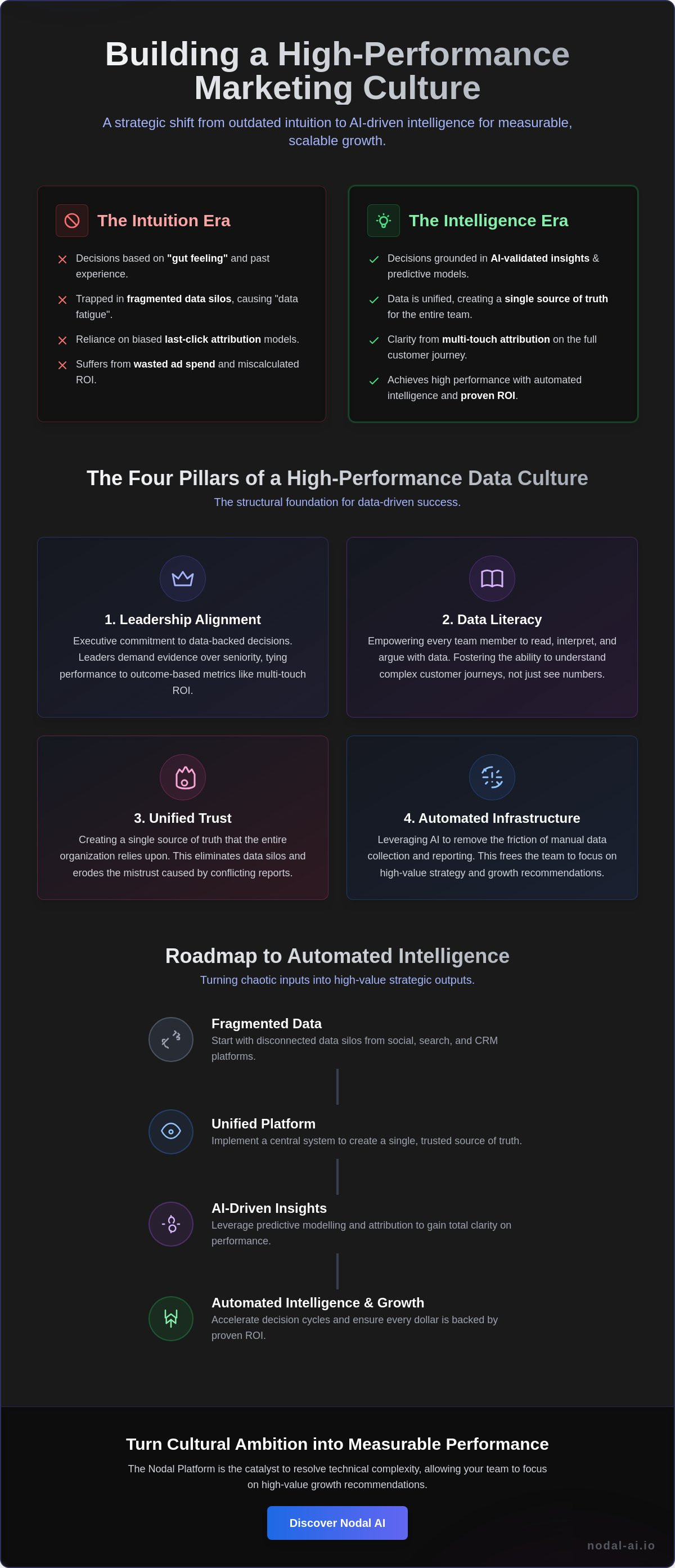
In 2026, building a data-driven marketing culture means more than just buying a new dashboard. It represents a fundamental shift in how your team perceives reality. We've moved past the "Intuition Era," where last-click attribution and vanity metrics dictated strategy. We've entered the "Intelligence Era." Here, a collective reliance on unified, AI-validated insights replaces the "gut feeling" of the past. Culture is your biggest barrier to AI success. If your team doesn't trust the numbers, they won't use the tools. We're here to turn your chaotic inputs into high-value strategic outputs.
The Shift from Instinct to Predictive Insight
Relying on instinct in a multi-channel world is a liability. Your customers don't follow a straight line. They bounce between devices and platforms, making the broader context of Digital marketing more complex than ever. When you rely on "gut feeling," you're essentially guessing which touchpoint actually drove the sale. This lack of transparency leads to wasted spend and missed opportunities.
By adopting predictive modelling, you stop reacting to what happened last week. You start anticipating what will happen next month. This shift moves your team from reactive reporting to proactive growth recommendations. Instead of asking "what happened," your team begins to ask "how do we optimize for what's coming." It's a cognitive upgrade for the entire organization that replaces anxiety with confidence.
Why Traditional Marketing Cultures Fail to Scale
Why do so many teams struggle? They're trapped in fragmented data silos. Social data lives in one corner, search in another, and your CRM in a third. These silos are active drains on your productivity. They create "data fatigue," where marketers spend more time cleaning spreadsheets than crafting strategies. When data is fragmented, trust erodes. Team members start questioning the validity of reports, leading to a return to safe, "intuitive" decisions that don't scale.
Building a data-driven marketing culture requires breaking these silos and replacing manual labor with automated intelligence. In a competitive global market, miscalculated ROI isn't just a mistake; it's a threat to your stability. Traditional cultures fail because they prioritize the process of gathering data over the act of using it. To scale, you must implement systems that provide total clarity, allowing your team to focus on high-level perspectives rather than tedious manual tasks.
The Four Pillars of a High-Performance Data Culture
Building a data-driven marketing culture requires more than just a software subscription. It demands a structural foundation that supports every decision, from top-level budget allocation to daily campaign tweaks. Without these pillars, your team will continue to operate in a fog of uncertainty. You must replace manual guesswork with a framework that prioritizes speed, accuracy, and shared accountability. Success depends on these four critical areas.
- Leadership Alignment: Executive-level commitment to data-backed decision-making.
- Data Literacy: Training every team member to interpret complex customer journeys.
- Unified Trust: Creating a single source of truth that everyone relies on.
- Automated Infrastructure: Using AI to remove the friction of manual data collection.
Leadership: Modeling Data-Driven Behavior
CMOs cannot simply talk about data; they must live it. To foster a high-performance environment, leaders must demand data-backed recommendations in every meeting. If a strategy isn't supported by unified metrics, it shouldn't move forward. This creates a culture where evidence is valued over seniority. You should also consider tying performance bonuses to outcome-based metrics, such as lifetime value or multi-touch ROI, rather than simple activity levels. Leadership Accountability means ensuring that your data governance framework protects your assets while turning them into active participants in your business growth. When leaders model this behavior, the rest of the organization follows suit naturally.
Data Literacy vs. Data Democratisation
There's a significant difference between knowing the numbers and understanding the journey. Data literacy is the ability to read, work with, and argue with data. In 2026, this is a non-negotiable skill for every marketer. However, you don't need a team of data scientists to achieve this. Advanced AI platforms democratise insights by removing the need for deep technical specialisation. They translate complex algorithms into clear, actionable growth recommendations. Your goal is to train your team to ask "Why?" instead of just "What happened?". When a non-technical marketer can explain how a specific touchpoint influenced a conversion, you've reached the pinnacle of building a data-driven marketing culture. To see this in action, you can explore how to unify your performance metrics for better team clarity.
Unified trust is the final piece of the puzzle. When every department looks at the same dashboard and sees the same truth, friction disappears. Automated infrastructure supports this by handling the tedious work of reporting. It frees your team to focus on high-level perspectives and strategic optimization. By removing the manual burden, you replace the anxiety of "data fatigue" with the confidence of streamlined, high-level perspectives.
Beyond Last-Click: The Cultural Shift to Multi-Touch Attribution
"Our current attribution works fine" is perhaps the most dangerous phrase in modern marketing. It's a defense mechanism for a culture stuck in the "Intuition Era." When you rely on last-click metrics, you're only seeing the final step of a marathon. This bias creates a culture of short-term thinking, where teams optimize for the immediate click rather than long-term growth. Building a data-driven marketing culture requires a fundamental shift in how you value every interaction. You must move from a single-point perspective to a high-level view of the entire ecosystem.
Research shows that 41% of marketers still use last-touch models, even though the average customer journey now involves 6.5 touchpoints. By mastering marketing attribution, you provide your team with a cognitive upgrade. This transition replaces the anxiety of "gut-feeling" investments with the confidence of AI-validated insights. It changes team priorities from defending silos to optimizing the total path to purchase.
The Hidden Cost of Misallocated Ad Spend
Last-click models often lead to a catastrophic mistake: cutting high-value top-of-funnel channels. If a social ad introduces a customer to your brand but a search ad closes the deal, last-click gives 100% of the credit to search. You then cut the social budget, and suddenly, your search volume disappears. This is the hidden cost of misallocated spend. AI-driven insights resolve the "Walled Garden" problem by looking across platforms to identify true incrementality. It proves the value of your awareness efforts, turning passive assets into active participants in your revenue engine. Stop guessing which 50% of your budget is working. Use multi-touch attribution (MTA) to see the full picture.
Aligning Teams Around the Unified Customer Journey
Internal friction often stems from a lack of transparency. Brand teams want credit for awareness, while performance teams focus on conversions. These silos collapse when you establish a shared vocabulary around the customer journey stages. Transparency in data reduces inter-departmental friction because everyone looks at the same truth. When your "Brand" and "Performance" teams align around unified metrics, they stop competing for budget and start collaborating on growth. This cultural alignment is the hallmark of a mature, data-driven organization. It transforms your marketing department from a cost center into a high-performance growth engine that prioritizes measurable returns over vanity metrics.
A Strategic Roadmap: From Fragmented Data to Automated Intelligence
Building a data-driven marketing culture requires a structured sequence rather than a series of disconnected experiments. You must bridge the gap between chaotic inputs and high-value strategic outputs. This roadmap provides the technical and operational steps to turn your information into a cognitive upgrade for your entire team. By following this path, you replace the anxiety of manual labor with the confidence of streamlined, high-level perspectives.
Step 1: The Technical Foundation
Audit your sources. Identify the blind spots that obscure your view of the true customer journey. Integrate fragmented sources like Google, Meta, and your CRM into a single, high-performance engine. In 2026, compliance is not optional. New standards like the Indiana Consumer Data Protection Act (ICDPA) and Rhode Island’s RIDTPPA demand precise data handling and transparency. A unified AI marketing analytics platform ensures your infrastructure is both compliant and powerful. Set up automated reporting to kill the manual spreadsheet cycle. This single move can reclaim 20+ hours of team productivity per week, allowing your experts to focus on strategy instead of data entry.
Step 2: Operationalising Insights
Move beyond static dashboards. Static data is a relic of the Intuition Era; it tells you what happened but never why. Building a data-driven marketing culture means establishing a "test and learn" framework for rapid experimentation. Use AI-driven growth recommendations to guide your budget reallocation in real time. Instead of the traditional "Reporting Dump" that overwhelms your staff, establish a monthly Insight Review. This meeting should focus exclusively on future-facing actions and ROI optimization. When your team sees that data leads to immediate, profitable changes, their resistance to new tools will vanish. They will begin to view data as a conversational partner rather than a cold algorithm.
Success in this transition depends on the ease of the user experience. If the technology feels like a hurdle, the culture will revert to guesswork. You must provide your team with tools that make clarity feel inevitable. To see how you can streamline your transition and eliminate technical friction, you can unify your data streams with our performance tools. This is the moment to turn your passive data assets into active participants in your business growth.
Nodal AI: Turning Cultural Ambition into Measurable Performance
Ambition alone won't bridge the gap between chaotic data and strategic growth. You need a technical catalyst that transforms passive information into active intelligence. The Nodal Platform serves as this engine; it resolves the complexity that often stalls progress. By unifying your systems, we empower your team to move past the anxiety of "gut-feeling" guesses. Building a data-driven marketing culture becomes a natural evolution when the right tools are in place. We replace the manual grind with a high-level perspective that prioritizes measurable returns.
Speed is the ultimate competitive advantage in 2026. While your competitors struggle with disconnected spreadsheets, your team can leverage automated intelligence. Our platform turns fragmented streams into clear, actionable growth recommendations in real time. This isn't just about software; it's about a cognitive upgrade for your entire organization. We provide the clarity you need to lead with confidence in a rapidly shifting market. You stop chasing metrics and start driving outcomes.
Automating the Path to Strategic Clarity
Nodal AI removes the soul-crushing manual labor of data analysis. Instead of wasting hours on cleaning datasets, your marketers can focus on high-value creative strategy. Our AI-driven multi-touch attribution provides the granular detail needed for enterprise-level decision making. It identifies exactly where your revenue is coming from across every touchpoint. This automation doesn't just save time. It increases revenue by identifying profitable opportunities that human analysis often misses. You gain total transparency, ensuring every penny of ad spend is accounted for and optimized through predictive modelling.
Your Partner in the 2026 Marketing Landscape
As a visionary leader in UK and global performance marketing, Nodal AI understands the unique pressures of the modern landscape. We offer more than just analytics; we provide a partnership grounded in security and stability. Our enterprise-ready SaaS solution is built to handle the rigorous demands of current data governance while remaining accessible to non-technical users. We help you move from fragmented chaos to a streamlined future where growth is predictable and scalable. Building a data-driven marketing culture is the final step in your digital transformation. Don't let technical hurdles hold your team back from their full potential. Transform your marketing culture with Nodal AI today.
Master Your Performance Marketing Evolution
The transition from intuition to intelligence is no longer optional for brands aiming to lead in 2026. By prioritizing AI-powered multi-touch attribution and predictive modelling, you replace guesswork with measurable returns. Building a data-driven marketing culture requires both a mental shift and a technical infrastructure that resolves complexity. You've seen how unifying fragmented streams and automating reporting can reclaim 20+ hours of team productivity every single week. This is the cognitive upgrade your organization needs to thrive in a competitive landscape.
Now it's time to turn these strategic insights into actionable results. Our London-based experts provide personalized onboarding to ensure your transition from chaotic inputs to high-value outputs is frictionless. Stop letting manual labor drain your resources and start focusing on high-level growth recommendations. You have the roadmap; we have the engine to drive it forward. Book a Nodal AI demo to see how we unify your fragmented marketing data. Your journey toward total clarity and accelerated ROI starts today.
Frequently Asked Questions
What is the first step in building a data-driven marketing culture?
The first step is auditing your current technical infrastructure to identify data silos and journey blind spots. You can't change a culture if the underlying data remains fragmented and untrusted. Start by unifying your sources into a single source of truth. This removes the friction of manual collection and sets the stage for executive and team alignment.
How long does it take to see results from a data-driven culture shift?
Initial operational results, such as reclaimed time from automated reporting, often appear within the first four weeks. Strategic results, including improved ROI through multi-touch attribution, typically materialize within 90 days. This timeframe allows for enough data collection to validate new predictive models and refine your testing framework for consistent, profitable growth.
Is a data-driven culture only for large enterprises with big data teams?
No, advanced AI platforms democratise these capabilities for organizations of all sizes. You don't need a massive data science department when your analytics platform provides automated growth recommendations. Small and mid-sized teams actually benefit most from the efficiency gains that come with building a data-driven marketing culture; it allows them to compete with larger rivals.
What is the difference between being data-informed and data-driven?
Data-informed teams use metrics to support their existing intuition, while data-driven teams allow unified insights to dictate the strategy. In a data-driven model, the numbers act as the primary decision-maker. This shift replaces subjective gut feelings with objective, AI-validated outcomes that ensure long-term stability and remove the anxiety of uncertain investments.
How do we overcome team resistance to new marketing analytics tools?
Focus on the immediate relief that automation provides by removing tedious manual tasks. Show your team how a platform saves them 20+ hours a week on reporting and data cleaning. When they see that technology acts as a cognitive upgrade rather than a threat, their resistance transforms into enthusiastic adoption of more strategic, high-level work.
What are the most important KPIs for a data-driven marketing team in 2026?
Focus on outcome-based metrics like Multi-Touch ROI, Customer Lifetime Value (CLV), and Incrementality. Vanity metrics such as clicks or impressions are secondary to these financial performance indicators. These specific KPIs ensure every marketing dollar is tied to a concrete business outcome and contributes to the long-term protection and growth of your assets.
Can AI platforms really replace manual marketing reporting?
Yes, modern AI platforms completely automate the ingestion, cleaning, and visualization of data from disparate sources. This replaces the error-prone process of manual spreadsheet management with streamlined, real-time dashboards. Building a data-driven marketing culture relies on this automation to ensure your team spends their energy on high-value strategy rather than the manual labor of data entry.


